

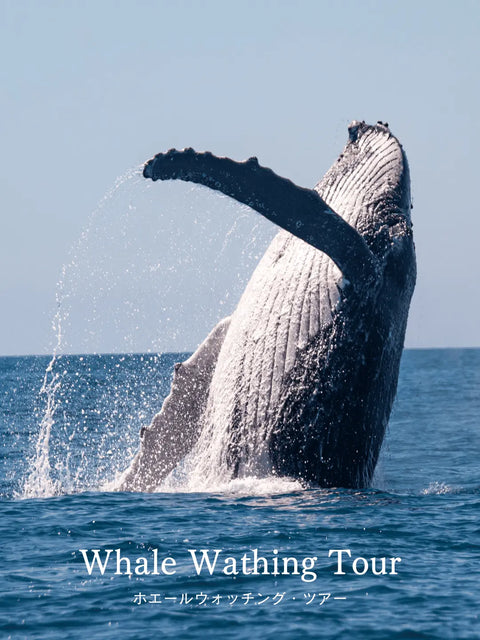
Whale Watching Tour | Amami Oshima


showing dynamic actions
Humpback Whale
Tour for observation on a large boat
Humpback whales migrate from cold seas like Siberia to the warm seas near Amami Oshima for calving from winter to spring.

● They display various dynamic behaviors, such as whale songs (singing-like calls) and jumping out of the water.
● Observe the whales' blows (spouting), breaches (jumping), and tail slaps (the action of slapping the water surface with their tails) up close.
● If you are lucky, you may also see mother whales with baby whales.

【Period】
The best season is from December to around March.
In particular, February is the best season to see many mother and baby whales during calving and nurturing. During this time, it is said that there is a high probability of encountering them, over 90%.


・Observation is done on a large boat that is stable and has little sway.
・It is about a 5-6 minute walk from the Ryukyu Villa to the departure point.
・After the tour, you can use the sauna at the Ryukyu Villa. (*Reservation required separately. Sauna fees apply separately.)
Guests of the Ryukyu Villa can enjoy whale watching tours.
10% discount price
is available for use.


【Limited to 2 groups per day, private rental of 1 building】
Experience the ultimate relaxation with a sauna and bonfire at this modern Japanese-style art villa.
“Okinawan Dynasty Era Architectural Techniques × Art”
This villa is a modern building that incorporates traditional Okinawan architectural techniques and blends them with art. Enjoy an extraordinary experience at this art museum where you can stay.
>> For more details, please see here

Tour Duration: 4 hours
① Morning: 8 AM - 12 PM
② Afternoon: 1 PM - 5 PM
Price: 8,000 yen per adult / 7,000 yen per child (0 years old to elementary school)
Meeting Place:Ashitoku Fishing Port
Details & Reservations
>> Here
▼Service Provided by: Totora Marine
〒894-0411 Kagoshima Prefecture, Oshima District, Ryugyo Town, Akaogiki 1572-2
▼Contact Us
maremonte45@gmail.com
090(3669)4535

In the waters around Amami Oshima, there is a rare opportunity to encounter "humpback whales" from winter to spring. They are considered medium-sized among whales, but fully grown humpback whales can reach lengths of 13 to 15 meters, about the size of a four-story building! Additionally, they weigh around 30 tons, which is as impressive as three large buses gathered together.
Above all, the charm of the humpback whale lies in the dynamic actions unfolding right before your eyes. Moments that take your breath away, such as breaching with their bodies thrown high into the air and raising their tail fins high, are continuous.
Knowing whale behavior in advance will make your whale watching experience even more thrilling. Enjoy special encounters in the sea of Amami.
Blow

A blow refers to the "spouting" that whales do at the water's surface, which is an important sign for breathing. Whales, like humans, are mammals that breathe with lungs, so they surface approximately every 15 to 20 minutes, forcefully blowing out a white mist-like breath 3 to 5 times. The sound and power of it are truly moving when seen up close.
Furthermore, depending on the angle of sunlight, a rainbow can appear over the blow, or it may look softly heart-shaped. If you encounter such a special moment, your memories of whale watching will surely deepen.
Peduncle Arch

Peduncle arch refers to the movement that a whale shows when it dives into the sea. "Peduncle" refers to the dorsal fin, which is gently lifted in an arc just before diving, as it quietly disappears into the ocean. Its elegant curve is a beauty that captivates just by watching.
Additionally, the humpback whale is written in kanji as "座頭鯨," which is said to be named because the rounded shape of its back resembles that of a blind monk carrying a biwa. Observing with this origin in mind can make the whale's appearance feel even more endearing.
Fluke Up/Down

When a whale finishes surfacing for air and dives deeply, it raises its tail fin high above the water's surface before submerging. At this time, the movement of diving while showing the underside of the tail fin is called "fluke up," while diving without showing the underside is called "fluke down."
In fact, the patterns on the underside of this tail fin are like "fingerprints" in humans, with each whale having a completely different design. Therefore, this pattern is used as a clue for identifying individual whales. When whale watching, paying attention to the patterns on the tail fin can make the observation even more enjoyable.
Tail Slap

A tail slap is a dynamic action where the whale lifts its massive tail fin, about 5 meters long, high and forcefully slaps it against the surface of the water. The loud sound that echoes across the sea and the splash that exceeds expectations are truly remarkable. Since it often occurs repeatedly, it’s also a great opportunity for taking photos and videos.
This behavior is believed to signal its presence to the surroundings or to serve as a form of intimidation. If you encounter an impressive tail slap, the excitement of whale watching will undoubtedly increase dramatically.
Pectoral Slap

Pectoral slap refers to the action of the whale slapping its long and large pectoral fins against the surface of the water. The pectoral fins of humpback whales are about one-third of their body length, and due to their graceful length, they are often referred to as "the whales with the most beautiful pectoral fins." Sometimes, both pectoral fins are slapped simultaneously, creating a very impressive sound and splash on the surface.
This behavior is thought to occur when the whale is relaxed or as a form of intimidation towards others. Especially the small pectoral slaps shown by calves are so adorable that they can’t help but bring a smile to your face.
Head Slap

A head slap is an impressive action where the whale lifts its large head high and forcefully slaps it against the surface of the water. When performed by a fully grown whale, it creates such a large splash that the sea shakes, and the moment can take your breath away. If the timing is right, you might witness a dynamic scene where it repeatedly slaps its head.
This behavior is believed to be performed to showcase its strength or to intimidate surrounding whales. If you see a head slap right in front of you, the excitement of whale watching will surely rise dramatically.
Spy Hop

A spy hop is a very unique behavior where the whale gently raises its head above the water's surface, slowly turns its body to look around, and then sinks back down. Although it is a rare gesture not often seen in humpback whales, it is said to be frequently observed in gray whales that often move along the coast.
This behavior is thought to be performed to check the surrounding terrain and position, helping the whale decide which direction to swim. If you encounter a spy hop, it will be a very lucky moment. It’s a somewhat mysterious and adorable scene where the whale seems to be "observing us."
Peduncle Slap

Peduncle slapping is a powerful action where the whale forcefully slaps its tail fin against the surface of the water. Sometimes, it swings its tail down as if lifting its entire lower body, or it may show vigorous side-to-side movements near the surface. The impact is overwhelming, causing the sea to splash up significantly.
This behavior is considered particularly aggressive among whales, and it is said that male humpback whales often do it during the breeding season. It is frequently seen as a display of intimidation towards rival males or during competition for females, making it a moment to feel the drama of the wild.
Breaching

Breaching is a spectacular performance where the humpback whale jumps powerfully out of the water. The sight of its massive body, over 10 meters long and weighing 30 tons, splashing through the air is truly breathtaking.
The probability of encountering breaching during whale watching is said to be about 20%, but if you see it right in front of you, everyone gets incredibly excited! It's a moment to fully experience the charm of the humpback whale.
Amami Whale Watching | Amami Oshima Whale Watching | Amami | Amami Oshima | Whale Observation Tour

